

Reed Switches Explained
Some electronic parts use electricity, light, temperature, pressure or sound to sense changes in their environment. Reed switches are another story. They respond to magnetic fields so can be operated without physical contact, external power or complex electronics.
Invented almost a century ago, reed switches are still widely used in modern electronics. They can be found in security systems, industrial automation, automotive applications, appliances, smart home devices and countless embedded projects.
The reason for their popularity is simply one powerful feature; a magnetic field can open or close an electrical circuit without having any direct mechanical contact between the switch and the object being detected.
Learning how a reed switch works is a great way to get to know one of the most reliable and versatile sensing technologies in electronics.
What Is a Reed Switch?
A reed switch is an electrically operated switch that is activated by a magnetic field.
Inside a small glass tube are two thin metal reeds positioned with a small gap between them.
When a magnetic field is applied:
- The reeds become magnetized
- They attract one another
- Electrical contact is made
When the magnetic field is removed:
- The reeds separate
- The circuit opens
This simple mechanism allows magnetic sensing without direct contact.
Why Is It Called a Reed Switch?
The name comes from the flexible metal contacts inside the switch.
These contacts resemble thin reeds and bend slightly when exposed to a magnetic field.
The movement is tiny, but it is enough to create a reliable electrical connection.
Internal Construction
A typical reed switch contains:
- Two ferromagnetic metal reeds
- Glass enclosure
- Inert gas or vacuum environment
- Connection leads
A simplified structure looks like:
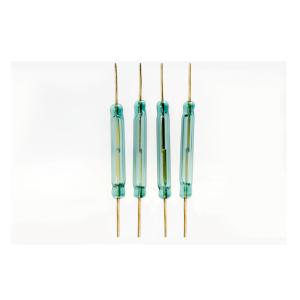
- reed switch
The glass enclosure protects the contacts from:
- Moisture
- Dust
- Corrosion
- Contamination
This contributes significantly to the switch’s reliability.
How a Reed Switch Works
In its normal state, the reeds are separated.
When a magnet approaches:
- Both reeds become magnetized
- Opposite magnetic poles form
- The reeds attract each other
Current can then flow through the switch.
Once the magnet moves away:
- Magnetic attraction disappears
- The reeds return to their original positions
- The circuit opens again
Why No Power Is Needed
One major advantage of reed switches is that they require no operating power.
Unlike:
- Hall effect sensors
- Infrared sensors
- Ultrasonic sensors
a reed switch simply responds to magnetic fields.
This makes them ideal for:
- Battery-powered devices
- Long-term installations
- Low-power systems
Normally Open Reed Switches
The most common type is the Normally Open (NO) reed switch.
In its resting state:
- Contacts are separated
- No current flows
When a magnet approaches:
- Contacts close
- Current flows
Most door and window sensors use normally open reed switches.
Normally Closed Reed Switches
Normally Closed (NC) reed switches operate differently.
Without a magnetic field:
- Contacts remain closed
When a magnet approaches:
- Contacts open
These are less common but useful in specific monitoring applications.
Changeover Reed Switches
Some reed switches provide both normally open and normally closed outputs.
These devices can perform more complex switching tasks and are often used in industrial equipment.
Magnetic Activation
The strength of the magnetic field determines whether the switch operates.
Factors affecting operation include:
- Magnet strength
- Distance
- Magnet orientation
- Switch sensitivity
A strong magnet can activate a switch from several centimetres away.
A weaker magnet may need to be much closer.
Operating Distance
Operating distance varies significantly.
Typical ranges include:
| Magnet Type | Approximate Distance |
|---|---|
| Small Ferrite Magnet | 5–15 mm |
| Medium Neodymium Magnet | 10–30 mm |
| Large Neodymium Magnet | 20–50 mm |
Actual values depend on switch specifications and magnet orientation.
Why Glass Is Used
The glass capsule serves several purposes.
Environmental Protection
The contacts remain sealed from:
- Moisture
- Dirt
- Oxidation
Longer Lifespan
Clean contacts reduce wear and contamination.
Improved Reliability
Electrical performance remains stable over many years.
The glass enclosure is one reason reed switches often last decades.
Reed Switch Contact Ratings
Although small, reed switches can handle useful amounts of current.
Typical ratings include:
| Type | Current Rating |
|---|---|
| Small Signal | 10mA–100mA |
| General Purpose | 500mA |
| Power Reed Switch | Several Amps |
Always verify the datasheet before selecting a switch.
Exceeding ratings can damage contacts.
Contact Bounce
Like other mechanical switches, reed switches can exhibit contact bounce.
When contacts close:
- They may briefly vibrate
- Multiple transitions occur
This usually lasts only milliseconds.
Microcontroller software often uses debounce routines to compensate.
Switching Speed
Reed switches are surprisingly fast.
Typical operating times include:
- Closing: 0.2ms to 2ms
- Opening: 0.1ms to 1ms
This is sufficient for most sensing applications.
Reed Switches vs Mechanical Switches
| Feature | Reed Switch | Mechanical Switch |
|---|---|---|
| Physical Contact Required | No | Yes |
| Sealed Contacts | Yes | Usually No |
| Environmental Resistance | High | Moderate |
| Wear Rate | Low | Higher |
| Activation Method | Magnetic | Physical |
The lack of external moving parts improves durability.
Reed Switches vs Hall Effect Sensors
Hall effect sensors are often compared with reed switches.
| Feature | Reed Switch | Hall Sensor |
|---|---|---|
| Power Required | No | Yes |
| Output Type | Mechanical Contact | Electronic |
| Complexity | Very Low | Moderate |
| Cost | Low | Low |
| Switching Speed | Fast | Very Fast |
| Lifespan | Long | Extremely Long |
Hall sensors are often preferred in advanced electronics, but reed switches remain attractive because they require no power.
Security System Applications
One of the most common uses is door and window monitoring.
A typical setup consists of:
- Reed switch mounted on frame
- Magnet mounted on door
When the door closes:
- Magnet activates switch
- Alarm system sees closed condition
When the door opens:
- Magnetic field disappears
- Switch changes state
- Alarm triggers
Millions of security systems use this principle.
Smart Home Applications
Reed switches appear in:
- Smart door sensors
- Window monitoring systems
- Cabinet sensors
- Garage door monitors
Their low power consumption makes them ideal for wireless battery-operated devices.
Industrial Automation
Industrial systems use reed switches for:
- Position sensing
- Limit detection
- Machine safety systems
- Cylinder position monitoring
Pneumatic cylinders often contain magnets that activate nearby reed switches.
Automotive Uses
Vehicles use reed switches for:
- Door detection
- Fluid level sensing
- Seat position sensing
- Security systems
Their reliability and simplicity make them attractive for harsh environments.
Liquid Level Sensors
Reed switches are commonly used in float switches.
A float containing a magnet moves with liquid level.
As the float rises:
- Magnet approaches switch
- Reed switch activates
This arrangement appears in:
- Water tanks
- Fuel systems
- Industrial process equipment
Embedded Electronics Projects
Reed switches are popular with:
- Arduino
- ESP32
- STM32
- Raspberry Pi Pico
Typical projects include:
- Door sensors
- RPM counters
- Position detection
- Security systems
- Smart home devices
Interfacing is straightforward because the switch behaves like a simple contact.
Reed Relays
A reed relay combines:
- Reed switch
- Electromagnetic coil
Instead of using a permanent magnet, an electrical current activates the coil.
Advantages include:
- Fast switching
- Excellent isolation
- Low contact resistance
Reed relays remain common in instrumentation equipment.
Advantages of Reed Switches
No Power Consumption
Ideal for battery-powered systems.
Long Service Life
Many switches exceed millions of operations.
Sealed Contacts
Protected from environmental contamination.
Compact Size
Suitable for space-constrained designs.
High Reliability
Excellent long-term performance.
Electrical Isolation
The magnet and circuit remain electrically separate.
Limitations of Reed Switches
Fragile Glass Package
Improper handling can cause breakage.
Contact Wear
Although minimal, mechanical contacts eventually wear.
Limited Current Capacity
Not suitable for very high-current loads.
Magnetic Interference
Nearby magnets can cause false triggering.
Slower Than Electronic Sensors
Hall effect sensors generally offer higher switching speeds.
Common Beginner Mistakes
Mounting the Magnet Incorrectly
Orientation matters.
The strongest magnetic field may not align with the switch.
Ignoring Contact Ratings
Excessive current can weld contacts together.
Forgetting Debounce
Rapid switching can produce multiple transitions.
Mounting Too Far Apart
Distance significantly affects sensitivity.
Testing before final installation is important.
Popular Reed Switch Applications
Reed switches are commonly found in:
- Alarm systems
- Smart home sensors
- Industrial automation
- Medical equipment
- Automotive electronics
- Vending machines
- Appliances
- Float switches
- Position sensors
- Embedded systems
Their versatility ensures continued use across many industries.
The Future of Reed Switches
While solid-state magnetic sensors continue to gain popularity, reed switches remain relevant because of their simplicity, reliability, and zero-power operation.
In applications where:
- Ultra-low power consumption matters
- Simplicity is preferred
- Long-term reliability is essential
reed switches continue to provide an elegant solution.
Conclusion
Reed switches are simple yet highly effective magnetic switches that allow circuits to be controlled without physical contact or external power. Their sealed construction, low cost, long lifespan, and excellent reliability have made them indispensable in security systems, industrial automation, liquid level sensing, and embedded electronics.
Although modern Hall effect sensors offer additional capabilities, reed switches remain one of the most practical and widely used magnetic sensing technologies available. Their ability to provide reliable switching with minimal complexity ensures they will continue to play an important role in electronic systems for years to come.