

Understanding TRIACs
Many electronic components are designed to switch DC circuits on and off. However, controlling alternating current (AC) presents unique challenges because the current changes direction dozens or even hundreds of times every second.
For decades, one of the most popular solutions for AC power control has been the TRIAC. Found in light dimmers, fan speed controllers, heater controls, power tools, and industrial equipment, TRIACs allow efficient switching and regulation of mains-powered devices without the mechanical wear associated with relays.
Although modern solid-state technologies continue to evolve, TRIACs remain one of the most important components in AC power electronics. Understanding how they work provides valuable insight into household appliances, industrial controls, and power management systems.
What Is a TRIAC?
A TRIAC is a semiconductor switching device designed to control alternating current.
The name stands for:
TRIode for Alternating Current
Unlike a conventional transistor, which typically controls current in one direction, a TRIAC can conduct current in both directions.
This makes it especially suitable for AC circuits where current continually reverses direction.
A TRIAC can be thought of as an electronically controlled AC switch.
Why TRIACs Were Developed
Before TRIACs became common, AC control often relied on:
- Mechanical relays
- Switches
- Contactors
While effective, these devices have limitations:
- Mechanical wear
- Audible clicking
- Arcing
- Slower switching speeds
TRIACs eliminate moving parts entirely.
Benefits include:
- Silent operation
- Long lifespan
- Fast switching
- Compact size
- High reliability
TRIAC Terminal Names
A TRIAC has three terminals:
- Main Terminal 1 (MT1)
- Main Terminal 2 (MT2)
- Gate (G)
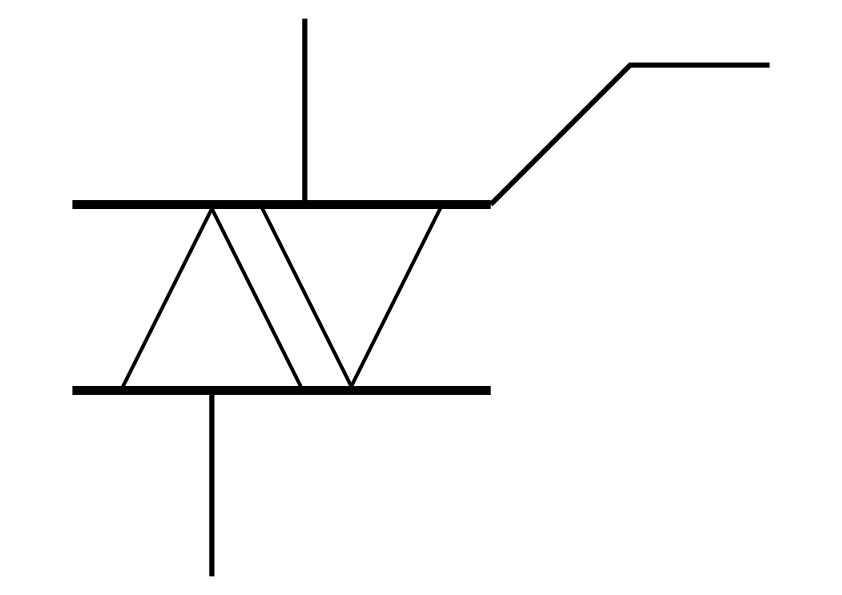
The gate controls when the TRIAC begins conducting.
How a TRIAC Differs from an SCR
To understand a TRIAC, it helps to compare it with an SCR (Silicon Controlled Rectifier).
SCR
An SCR conducts current in only one direction.
It behaves like a controlled diode.
TRIAC
A TRIAC conducts current in both directions.
It effectively behaves like two SCRs connected in opposite directions.
A simplified representation looks like:
SCR →← SCR
This bidirectional capability makes TRIACs ideal for AC circuits.
Basic Operating Principle
A TRIAC normally blocks current flow between MT1 and MT2.
When a small trigger current is applied to the gate:
- The TRIAC turns on
- Current flows through the load
- Conduction continues even after the gate signal is removed
This behavior is known as latching.
The Latching Effect
One characteristic that often surprises beginners is that the gate only needs a brief trigger pulse.
Once switched on:
- Current continues flowing
- The TRIAC remains conducting
- Gate current is no longer required
The device turns off only when current falls below a specific value called the holding current.
Why TRIACs Work Naturally with AC
AC voltage continuously crosses zero.
For example:
- 50 Hz mains crosses zero 100 times per second
- 60 Hz mains crosses zero 120 times per second
At each zero crossing:
- Current falls to zero
- TRIAC automatically turns off
The control circuit simply decides whether to trigger the TRIAC during the next cycle.
This natural switching mechanism makes TRIACs highly effective for AC control.
AC Waveforms and TRIAC Operation
A normal AC waveform looks like:
Voltage

  +      /\      /\
         /  \    /  \
        /    \  /    \
-------/------\/------\------
      /              /
     /              /
    \/             \/

  -
Without triggering:
- No power reaches the load
With triggering:
- Portions of the waveform are delivered to the load
The timing of the trigger determines power output.
Phase Angle Control
One of the most important TRIAC techniques is phase angle control.
Instead of switching at the start of each AC cycle, the TRIAC waits for a specific delay.
Examples:
Early Trigger
Cycle begins
|
|----Trigger
Most of the waveform reaches the load.
Result:
- High power
Late Trigger
Cycle begins
|
|--------------Trigger
Only part of the waveform reaches the load.
Result:
- Reduced power
This method forms the basis of light dimmers and speed controllers.
How Light Dimmers Work
Traditional incandescent dimmers use TRIACs.
When the dimmer knob is adjusted:
- Trigger timing changes
- Power delivered changes
- Brightness changes
Unlike a variable resistor, very little energy is wasted as heat.
This makes TRIAC dimmers far more efficient.
Motor Speed Control
Many AC motor controllers use TRIACs.
Examples include:
- Fans
- Blowers
- Small power tools
- Vacuum cleaners
By reducing the average voltage applied to the motor:
- Speed decreases
- Power consumption drops
This provides smooth speed control.
Heater Control
Electric heaters are another common application.
TRIAC-based controllers can regulate:
- Space heaters
- Soldering stations
- Ovens
- Industrial heaters
Benefits include:
- Precise temperature control
- Silent operation
- Long service life
Understanding Trigger Current
The gate requires only a small current to activate the TRIAC.
Typical values may range from:
- A few milliamps
- Tens of milliamps
depending on the device.
This allows low-power circuits to control high-power loads safely.
Four Triggering Quadrants
Unlike many semiconductor devices, TRIACs can be triggered under multiple voltage and current conditions.
These operating regions are known as quadrants.
Quadrant I
- MT2 positive
- Gate positive
Most sensitive operation.
Quadrant II
- MT2 positive
- Gate negative
Common in some circuits.
Quadrant III
- MT2 negative
- Gate negative
Often used during negative half-cycles.
Quadrant IV
- MT2 negative
- Gate positive
Usually least sensitive.
Most designers simply use application circuits from datasheets rather than calculating quadrant operation manually.
TRIAC Voltage Ratings
Common voltage ratings include:
| Device | Voltage Rating |
|---|---|
| BT136 | 600V |
| BT137 | 600V |
| BTA16 | 600V |
| BTA24 | 600V |
| BTA41 | 600V–800V |
These ratings are suitable for most mains-powered applications.
Current Ratings
TRIACs are available in various current ratings.
Typical examples include:
| Device | Current Rating |
|---|---|
| BT136 | 4A |
| BT137 | 8A |
| BTA16 | 16A |
| BTA24 | 24A |
| BTA41 | 40A |
The chosen device must comfortably exceed expected load current.
TRIACs and Optocouplers
Directly connecting microcontrollers to mains electricity is dangerous.
Instead, designers often use optically isolated drivers.
Popular examples include:
- MOC3021
- MOC3041
- MOC3063
An optocoupler provides:
- Electrical isolation
- Improved safety
- Noise immunity
This allows platforms such as:
- Arduino
- ESP32
- STM32
- Raspberry Pi Pico
to safely control mains-powered equipment.
Zero-Cross TRIAC Drivers
Some optocouplers include zero-cross detection.
They trigger the TRIAC only when AC voltage crosses zero.
Advantages include:
- Reduced EMI
- Lower electrical noise
- Cleaner switching
These are ideal for simple ON/OFF control.
Random-Fire Drivers
Random-fire drivers allow triggering at any point in the AC cycle.
Advantages:
- Dimming
- Speed control
- Power regulation
They are commonly used in phase-angle applications.
Common TRIAC Part Numbers
Popular devices include:
- BT136
- BT137
- BT138
- BTA08
- BTA16
- BTA24
- BTA41
These components are inexpensive and widely available.
Advantages of TRIACs
Silent Operation
No moving contacts.
Long Life
No mechanical wear.
Efficient Control
Minimal power loss.
Compact Design
Smaller than equivalent relay systems.
Fast Switching
Suitable for precise control applications.
Limitations of TRIACs
AC Only
TRIACs are primarily designed for AC circuits.
They are generally unsuitable for standard DC switching.
Electrical Noise
Phase-angle control generates electromagnetic interference.
Not Ideal for Every Load
Certain inductive or electronic loads can create switching challenges.
Heat Generation
At high currents, heatsinks may be required.
TRIACs vs Relays
| Feature | TRIAC | Relay |
|---|---|---|
| Moving Parts | No | Yes |
| Silent Operation | Yes | No |
| AC Control | Excellent | Excellent |
| DC Control | Poor | Excellent |
| Isolation | Requires Optocoupler | Built-In |
| Lifespan | Very Long | Limited |
| Switching Speed | Fast | Slower |
Both technologies remain valuable depending on the application.
TRIACs vs MOSFETs
| Feature | TRIAC | MOSFET |
|---|---|---|
| AC Control | Excellent | Requires additional circuitry |
| DC Control | Poor | Excellent |
| Simplicity for Mains Control | High | Lower |
| Cost | Low | Moderate |
| Typical Use | Dimmers, heaters | DC electronics |
Common Beginner Mistakes
Using TRIACs for DC Loads
A TRIAC may latch permanently when used on DC because current never naturally crosses zero.
Ignoring Isolation
Microcontrollers should never connect directly to mains voltages.
Always use proper isolation methods.
Undersized TRIAC Selection
Current ratings should include safety margins.
Forgetting Heatsinks
High-current applications often require thermal management.
Real-World Applications
TRIACs can be found in:
- Light dimmers
- Fan controllers
- Motor speed controllers
- Smart home switches
- Temperature controllers
- Coffee machines
- Washing machines
- Air conditioning systems
- Industrial automation equipment
Millions of TRIACs operate daily inside household and industrial electronics worldwide.
The Future of TRIAC Technology
While solid-state relays, MOSFET-based AC switches, and IGBT systems continue to grow in popularity, TRIACs remain one of the most economical and effective methods for controlling mains-powered loads.
For low-cost AC switching, dimming, and power regulation, they continue to offer an attractive balance of simplicity, performance, and reliability.
Conclusion
TRIACs are semiconductor devices specifically designed to control AC power. By conducting current in both directions and latching after a brief gate trigger, they provide efficient, silent, and reliable control of mains-powered equipment. Their ability to regulate power through phase-angle control has made them essential components in light dimmers, heater controls, motor speed controllers, and industrial automation systems.
Although newer technologies continue to emerge, TRIACs remain one of the most important and widely used components in AC power electronics.