

How Photodiodes Work
Modern electronics are increasingly making use of light. From fibre-optic communication systems and remote controls to medical equipment and industrial sensors, many devices require a method to accurately detect and measure light.
The photodiode is one of the most important parts of this task. Despite its tiny size and simple appearance, a photodiode can convert light directly into an electrical signal with remarkable speed and precision.
Photodiodes are used in smartphones, barcode scanners, laser rangefinders, optical communication systems, smoke detectors, scientific instruments, and countless embedded applications. They are a reliable method of sensing light levels, optical signals and infrared radiation.
How photodiodes work explains how electronic systems are able to “see” and react to their surroundings.
What Is a Photodiode?
A photodiode is a semiconductor device that converts light into electrical current.
Unlike a standard diode, which is primarily designed to conduct electrical current in one direction, a photodiode is specifically designed to respond to incoming light.
When photons strike the device:
- Charge carriers are generated
- Electrical current is produced
- The amount of current depends on light intensity
This makes photodiodes extremely useful as light sensors.
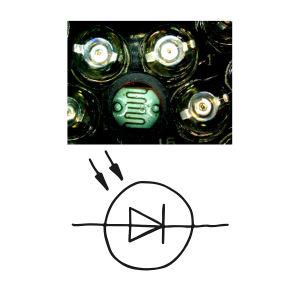
Photodiodes
Why Photodiodes Are Important
Electronic systems cannot directly detect light.
A photodiode acts as a bridge between:
Light Energy
        ↓
Electrical Signal
This allows electronic circuits to process optical information.
Applications include:
- Light measurement
- Object detection
- Optical communication
- Medical sensing
- Industrial automation
Basic Structure of a Photodiode
A photodiode is constructed using a semiconductor PN junction.
A simplified structure looks like:
Light
 ↓↓↓↓↓

P-Type Layer
-------------
Depletion Region
-------------
N-Type Layer
The depletion region plays a crucial role in converting light into electricity.
What Are Photons?
Light consists of tiny packets of energy called photons.
When photons strike a semiconductor:
- Energy is transferred
- Electrons gain energy
- Charge carriers are created
The photodiode converts this process into an electrical signal.
The Photoelectric Effect
Photodiodes operate using principles related to the photoelectric effect.
When sufficient light energy reaches the semiconductor:
- Electrons are released
- Electron-hole pairs form
- Electrical current becomes possible
This phenomenon is the foundation of many optical sensing technologies.
Understanding Electron-Hole Pairs
Inside the semiconductor:
- Electrons carry negative charge
- Holes behave as positive charge carriers
When light strikes the junction:
- New electron-hole pairs form
- The internal electric field separates them
- Current flows through the circuit
The more light received, the greater the current generated.
Reverse Bias Operation
Most photodiodes operate in reverse bias.
A typical connection looks like:
+V
 |
 |
Photodiode
 |
 |
GND
Unlike ordinary diodes, reverse bias improves photodiode performance.
Benefits include:
- Faster response
- Greater sensitivity
- Improved linearity
This operating mode is commonly called photoconductive mode.
Why Reverse Bias Improves Performance
Reverse bias widens the depletion region.
A larger depletion region:
- Captures more photons
- Separates charge carriers faster
- Reduces capacitance
The result is:
- Higher speed
- Better sensitivity
- Improved performance
This is particularly important in communication systems.
How Photocurrent Is Generated
The current generated by a photodiode is called photocurrent.
As light intensity increases:
- More photons arrive
- More charge carriers form
- More current flows
The relationship is approximately linear across much of the operating range.
Light Intensity and Current
For many photodiodes:
More Light → More Current
Less Light → Less Current
This predictable behavior makes them useful measurement devices.
Unlike simple switches, photodiodes can provide detailed information about light levels.
Dark Current
Even in complete darkness, a small current may flow.
This is known as dark current.
Sources include:
- Semiconductor leakage
- Thermal effects
- Manufacturing imperfections
High-quality photodiodes are designed to minimize dark current.
Photovoltaic Mode
Photodiodes can also operate without external bias.
This mode is called photovoltaic mode.
In photovoltaic operation:
- No external voltage is applied
- Light directly generates voltage
This behavior is similar to a solar cell.
Advantages include:
- Low noise
- Low power consumption
Disadvantages include:
- Slower response
- Reduced sensitivity
Photoconductive Mode
Most high-speed applications use photoconductive mode.
Characteristics include:
- Reverse bias applied
- Faster response
- Greater bandwidth
- Improved linearity
This mode dominates communication and sensing systems.
Photodiodes vs Solar Cells
Both devices convert light into electricity.
However, their goals differ.
| Feature | Photodiode | Solar Cell |
|---|---|---|
| Purpose | Sensing | Power Generation |
| Area | Small | Large |
| Response Speed | Very Fast | Slow |
| Sensitivity | High | Moderate |
| Output Power | Low | High |
A solar panel can be viewed as a large-area photodiode optimized for power production.
Spectral Response
Photodiodes are sensitive to specific wavelengths of light.
Common regions include:
- Ultraviolet
- Visible light
- Near infrared
Different semiconductor materials determine sensitivity.
Silicon Photodiodes
The most common photodiodes use silicon.
Advantages include:
- Low cost
- Good sensitivity
- High reliability
- Wide availability
Silicon photodiodes are particularly sensitive to:
- Visible light
- Near infrared light
Infrared Detection
Many photodiodes are optimized for infrared detection.
Applications include:
- TV remote controls
- Security systems
- Proximity sensors
- Optical communications
Infrared photodiodes are among the most common types in consumer electronics.
Photodiodes in Fibre Optic Communication
One of the most demanding applications is fibre-optic communication.
Optical fibres transmit data as light pulses.
Photodiodes convert those pulses back into electrical signals.
Modern systems may process:
- Gigabits per second
- Tens of gigabits per second
- Hundreds of gigabits per second
Photodiodes make this possible.
Avalanche Photodiodes
Some applications require extremely high sensitivity.
Avalanche photodiodes (APDs) provide internal amplification.
Operation involves:
- High reverse voltage
- Carrier multiplication
- Increased sensitivity
Advantages include:
- Better low-light performance
Disadvantages include:
- Greater complexity
- Higher cost
- Increased noise
PIN Photodiodes
A common high-performance design is the PIN photodiode.
Structure:
P Layer
Intrinsic Layer
N Layer
The intrinsic layer widens the depletion region.
Benefits include:
- Higher sensitivity
- Faster response
- Improved bandwidth
PIN photodiodes are widely used in communications and instrumentation.
Photodiodes in Remote Controls
Television remote controls use infrared light.
The receiver contains:
- Infrared photodiode
- Signal processing circuitry
When the remote transmits:
- Light pulses arrive
- Photodiode generates current
- Commands are decoded
This technology remains common worldwide.
Industrial Sensing Applications
Photodiodes appear in:
- Object detection systems
- Production line sensors
- Position monitoring equipment
- Safety systems
Their fast response makes them ideal for automation.
Medical Applications
Medical devices frequently use photodiodes.
Examples include:
- Pulse oximeters
- Blood analyzers
- Optical diagnostics
- Laboratory instruments
Many medical measurements depend on accurate light detection.
Barcode Scanners
Barcode readers rely on photodiodes to detect reflected laser light.
The photodiode measures:
- Reflected intensity
- Timing variations
The scanner converts this information into digital data.
Smoke Detectors
Optical smoke detectors use photodiodes to detect scattered light.
When smoke enters the chamber:
- Light scattering changes
- Photodiode output changes
- Alarm activates
This technique is widely used in residential and commercial safety systems.
Reading a Photodiode with a Microcontroller
Microcontrollers cannot directly measure photocurrent efficiently.
A common approach uses a resistor.
Photodiode
    |
 Resistor
    |
 ADC Input
The photocurrent creates a voltage across the resistor.
The ADC measures this voltage.
Platforms commonly used include:
- Arduino
- ESP32
- STM32
- Raspberry Pi Pico
Transimpedance Amplifiers
Professional photodiode circuits often use transimpedance amplifiers.
These circuits:
- Convert current into voltage
- Increase sensitivity
- Improve accuracy
Operational amplifiers are frequently used for this purpose.
Advantages of Photodiodes
High Speed
Capable of extremely fast response times.
Excellent Sensitivity
Can detect very small amounts of light.
Compact Size
Suitable for miniature devices.
Long Lifespan
No moving parts.
Reliable Operation
Excellent long-term stability.
Limitations of Photodiodes
Small Output Current
Amplification is often required.
Temperature Sensitivity
Performance can vary with temperature.
Dark Current
Small leakage currents exist even without light.
Alignment Requirements
Optical systems may require careful positioning.
Photodiodes vs Photoresistors
| Feature | Photodiode | Photoresistor |
|---|---|---|
| Speed | Very Fast | Slow |
| Accuracy | High | Moderate |
| Sensitivity | High | Good |
| Linearity | Excellent | Moderate |
| Precision Applications | Excellent | Limited |
Photodiodes are generally preferred when performance matters.
Common Beginner Mistakes
Reversing the Photodiode
Most applications require reverse bias operation.
Expecting Large Signals
Photodiodes usually produce small currents.
Amplification may be necessary.
Ignoring Ambient Light
Background lighting can affect measurements.
Poor Optical Shielding
Unwanted light sources may introduce errors.
Where You Will Find Photodiodes
Photodiodes appear in:
- Smartphones
- Fibre-optic networks
- Remote controls
- Industrial sensors
- Medical equipment
- Security systems
- Smoke detectors
- Laser rangefinders
- Scientific instruments
- Embedded electronics
They are among the most important optical sensing components in modern technology.
The Future of Photodiodes
As optical systems continue expanding, photodiodes remain critical components.
Emerging applications include:
- Autonomous vehicles
- LiDAR systems
- High-speed communications
- Biomedical sensing
- Optical computing
Their ability to convert light directly into electrical signals ensures their continued importance in future electronic systems.
Conclusion
A photodiode is a semiconductor device that converts light into current . Photons generate electron-hole pairs in the photodiode and this produces the current . Their speed, sensitivity, reliability and small size have made them a necessity in everything from remote controls, industrial sensors and fibre-optic communication systems to medical instruments.
Photodiodes are one of the most important sensing components in modern electronics. They allow circuits to interact with the optical world, acting as the electronic equivalent of a light detector.