

How Photoresistors Work
Many electronic systems need to sense changes in ambient light . Streetlights come on automatically at dusk, solar garden lights work after sunset, display brightness adjusts to ambient conditions, alarm systems monitor light levels to detect intrusions.
The photoresistor is one of the simplest components used for these tasks. A photoresistor, also known as a Light-Dependent Resistor (LDR), changes its electrical resistance according to the amount of light shining on its surface.
While newer technologies such as photodiodes and phototransistors are dominant in modern electronics, photoresistors still find wide use due to their low cost, ease of interfacing and high effectiveness for general light sensing applications.
Photoresistors are a great way to get started with light sensing and analogue electronics, and learn how photoresistors work.
What Is a Photoresistor?
A photoresistor is a resistor whose resistance changes in response to light intensity.
It is often called:
LDR
which stands for:
Light Dependent Resistor
Unlike ordinary resistors that maintain a fixed resistance value, an LDR’s resistance varies continuously depending on the amount of light it receives.
In simple terms:
More Light → Lower Resistance

Less Light → Higher Resistance
This characteristic allows circuits to measure ambient light levels.
Why Photoresistors Matter
Electronic circuits cannot directly detect light.
A photoresistor provides a simple method of converting:
Light
   ↓
Resistance Change
   ↓
Voltage Change
   ↓
Electrical Measurement
This enables electronic systems to respond automatically to lighting conditions.
The Principle Behind Photoresistors
Photoresistors operate using a phenomenon known as photoconductivity.
Certain semiconductor materials become more conductive when exposed to light.
When photons strike the surface:
- Energy is absorbed
- Additional charge carriers are generated
- Conductivity increases
- Resistance decreases
The brighter the light, the lower the resistance.
Common Materials Used
Traditional photoresistors are often manufactured using:
- Cadmium Sulfide (CdS)
- Cadmium Selenide (CdSe)
These materials exhibit strong changes in conductivity when illuminated.
Cadmium sulfide devices remain among the most common LDR types.
Basic Construction
A typical photoresistor consists of:
- Light-sensitive semiconductor layer
- Insulating substrate
- Metal contacts
- Transparent protective housing
A simplified structure looks like:
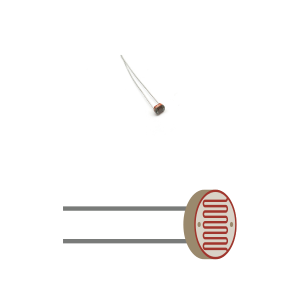
Photoresistors
The light-sensitive material is often arranged in a zigzag pattern to maximize active area.
What Happens in Darkness?
When little or no light is present:
- Very few charge carriers exist
- Conductivity is low
- Resistance becomes very high
Typical dark resistance values may be:
100 kΩ
500 kΩ
1 MΩ
10 MΩ
depending on the specific device.
What Happens in Bright Light?
As light intensity increases:
- More charge carriers form
- Conductivity rises
- Resistance falls dramatically
Typical bright-light resistance values may be:
100 Ω
500 Ω
1 kΩ
5 kΩ
This large resistance change makes LDRs easy to use in practical circuits.
Understanding Photoconductivity
The operation of an LDR differs from that of a photodiode.
Photodiodes generate current directly.
Photoresistors simply alter resistance.
When photons strike the semiconductor:
- Electrons gain energy
- Additional conduction paths form
- Resistance decreases
No external amplification is required for basic applications.
Light Intensity and Resistance
The relationship between light and resistance is not perfectly linear.
A typical response looks like:
Resistance

|
|\
| \
|  \
|   \
|     \
|       \____
|
+---------------- Light Intensity
As illumination increases:
- Resistance drops rapidly
This non-linear response must be considered in precision applications.
Measuring Light with a Voltage Divider
The most common method of using a photoresistor is a voltage divider.
A typical circuit looks like:
VCC
 |
Resistor
 |
 +---- Output
 |
LDR
 |
GND
As the LDR resistance changes:
- Output voltage changes
- Light level can be measured
This simple circuit appears in countless electronic products.
Why Voltage Dividers Are Used
Microcontrollers measure voltage rather than resistance.
The voltage divider converts:
Resistance Change
        ↓
Voltage Change
which can be read by an analog-to-digital converter (ADC).
Using Photoresistors with Microcontrollers
Photoresistors are commonly used with:
- Arduino
- ESP32
- STM32
- Raspberry Pi Pico
The ADC reads the voltage divider output and converts it into a digital value.
Software can then determine:
- Day or night
- Brightness level
- Threshold conditions
This makes LDRs extremely beginner-friendly.
Automatic Night Lights
One of the most common applications is automatic lighting.
During daylight:
- Resistance is low
- Circuit remains off
At night:
- Resistance increases
- Controller activates lighting
This principle is widely used in:
- Garden lights
- Security lighting
- Streetlights
Streetlight Control Systems
Many streetlights use light sensors to determine when illumination falls below a certain threshold.
The sensor system:
- Monitors ambient light
- Activates lamps at dusk
- Turns lamps off at dawn
Photoresistors have historically been popular for this purpose.
Display Brightness Adjustment
Some devices automatically adjust display brightness.
Examples include:
- Smartphones
- Tablets
- Laptops
- Information displays
The sensor detects ambient lighting and adjusts screen brightness accordingly.
Although photodiodes are common in modern devices, the underlying concept remains similar.
Alarm Systems
Photoresistors are often used to detect interruptions in light.
Examples include:
- Security beams
- Cabinet monitoring
- Access control systems
Changes in light levels trigger alarms or control actions.
Solar Garden Lights
Many solar-powered lights contain a photoresistor or similar sensor.
The circuit determines:
- Daytime → charging mode
- Nighttime → lighting mode
This simple approach allows automatic operation without user intervention.
Camera Exposure Systems
Historically, photoresistors were widely used in:
- Film cameras
- Light meters
They measured scene brightness and helped determine exposure settings.
Although newer sensors dominate today, LDRs played an important role in photographic technology.
Industrial Applications
Industrial systems use light sensing for:
- Conveyor monitoring
- Lighting control
- Equipment automation
- Environmental monitoring
Photoresistors remain attractive because of their simplicity and low cost.
Educational Electronics
LDRs are extremely popular in education because they demonstrate:
- Semiconductor behavior
- Analog sensing
- Voltage dividers
- ADC measurements
Many introductory electronics kits include photoresistors.
Advantages of Photoresistors
Extremely Simple
Minimal circuitry is required.
Low Cost
Among the least expensive light sensors available.
Easy to Interface
Works directly with microcontrollers.
Large Resistance Change
Provides strong response to changing light levels.
Wide Availability
Found in countless electronics suppliers.
Limitations of Photoresistors
Slow Response Time
Response may take milliseconds or longer.
Limited Precision
Not ideal for scientific measurements.
Temperature Sensitivity
Performance varies with temperature.
Nonlinear Response
Requires calibration for accurate measurements.
Cadmium Restrictions
Some regions restrict cadmium-containing components due to environmental concerns.
Photoresistors vs Photodiodes
| Feature | Photoresistor | Photodiode |
|---|---|---|
| Speed | Slow | Very Fast |
| Cost | Low | Moderate |
| Precision | Moderate | High |
| Circuit Complexity | Very Low | Higher |
| Light Measurement | Good | Excellent |
| Communications Use | Poor | Excellent |
Photodiodes are preferred for high-speed applications.
Photoresistors excel in simple light-sensing tasks.
Photoresistors vs Phototransistors
| Feature | Photoresistor | Phototransistor |
|---|---|---|
| Sensitivity | High | Very High |
| Speed | Slow | Faster |
| Complexity | Simple | Moderate |
| Cost | Lower | Slightly Higher |
Phototransistors are often used when faster response is required.
Typical Resistance Values
A common LDR may exhibit:
| Condition | Resistance |
|---|---|
| Bright Sunlight | 100 Ω – 1 kΩ |
| Indoor Lighting | 5 kΩ – 20 kΩ |
| Twilight | 20 kΩ – 100 kΩ |
| Darkness | 1 MΩ or More |
Actual values depend on the specific device.
Common Beginner Mistakes
Ignoring Non-Linearity
Light level and resistance do not change proportionally.
Forgetting the Voltage Divider
A microcontroller cannot directly measure resistance.
Expecting Fast Response
Photoresistors are slower than photodiodes.
Poor Sensor Placement
Nearby shadows or reflections may affect measurements.
Ignoring Temperature Effects
Environmental conditions can influence readings.
Popular LDR Part Types
Common photoresistors include:
- GL5528
- GL5537
- GL5549
- VT90N2
Specifications vary by sensitivity and resistance range.
Where You Will Find Photoresistors
Photoresistors appear in:
- Automatic lighting systems
- Solar garden lights
- Educational electronics
- Alarm systems
- Light meters
- Industrial controllers
- Smart home projects
- Embedded systems
- Environmental monitoring devices
- Consumer electronics
Despite their age, they remain useful components for simple light-sensing applications.
The Future of Photoresistors
While photodiodes and integrated light sensors increasingly dominate precision applications, photoresistors continue to be used where:
- Cost matters
- Simplicity is important
- High speed is unnecessary
Their ease of use ensures they remain popular among hobbyists, educators, and designers of low-cost electronic products.
Conclusion
Photoresistors or Light Dependent Resistors (LDRs) are simple semiconductors devices, whose resistance varies according to the intensity of light. They convert changes in illumination into measurable electrical signals, allowing electronic systems to detect levels of ambient light and react automatically.
Their low cost, ease of use and high resistance variation have made them useful components in automatic lighting systems, embedded electronics, alarm systems and school projects. Photoresistors still remain one of the easiest and most accessible ways to add light sensing to an electronic design, even though newer optical sensing technologies have better performance.