
Understanding Voltage Regulators
Every electronic device depends on stable voltage to operate correctly. Microcontrollers, sensors, displays, memory chips, communication modules, and processors all expect their power supply to remain within a specific voltage range. If the voltage becomes too high, components may be damaged. If it drops too low, circuits may malfunction, reset unexpectedly, or stop working altogether.
In the real world, power sources are rarely perfect. Batteries discharge over time, automotive systems experience voltage fluctuations, solar panels vary with sunlight conditions, and power adapters may contain ripple and noise.
Voltage regulators solve these problems by maintaining a stable output voltage regardless of changes in input voltage or load conditions. They are among the most important components in electronics, quietly ensuring that everything from simple embedded projects to complex industrial systems receives the power it needs.
Understanding voltage regulators is fundamental to understanding modern electronic design.
What Is a Voltage Regulator?
A voltage regulator is an electronic device or circuit that maintains a constant output voltage despite variations in:
- Input voltage
- Load current
- Temperature
- Operating conditions
Its primary job is to provide clean, stable power to electronic circuits.
A simplified arrangement looks like
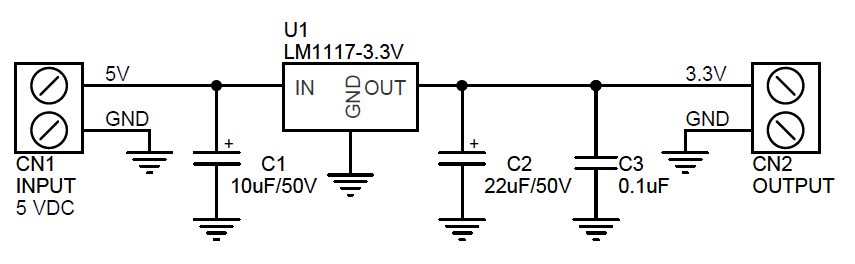
Without regulation, many electronic systems would be unreliable or unusable.
Why Voltage Regulation Is Necessary
Electronic components are designed to operate within specific voltage limits.
Examples include:
| Device | Typical Voltage |
|---|---|
| ESP32 | 3.3V |
| STM32 | 3.3V |
| Raspberry Pi Pico | 3.3V |
| Arduino Uno Logic | 5V |
| USB Devices | 5V |
Suppose an ESP32 is connected directly to a fully charged lithium-ion battery.
Battery voltage may vary between:
4.2V
and
3.0V
This exceeds the acceptable operating range of the ESP32.
A voltage regulator provides a constant 3.3V output despite battery voltage changes.
The Goal of a Voltage Regulator
The ideal regulator maintains:
V_=Constant
even when:
Vin changes
or
Load current changes
This stability protects electronic circuits and ensures predictable operation.
Common Sources of Voltage Variations
Many power sources experience fluctuations.
Batteries
Voltage changes as charge level decreases.
Automotive Systems
Vehicle electrical systems may range from:
11V to 15V+
under normal conditions.
Solar Panels
Output varies with:
- Sunlight
- Temperature
- Weather
Power Adapters
May contain:
- Ripple
- Noise
- Load-dependent variations
Voltage regulators compensate for these changes.
Types of Voltage Regulators
Voltage regulators generally fall into two categories:
- Linear regulators
- Switching regulators
Each has advantages and disadvantages.
Linear Voltage Regulators
Linear regulators are among the simplest voltage regulation devices.
They operate by continuously adjusting internal resistance to maintain a stable output voltage.
A typical example is the famous:
7805
which provides:
5V Output
from a higher input voltage.
How a Linear Regulator Works
A linear regulator behaves somewhat like a variable resistor.
When input voltage rises:
- Internal resistance increases
When input voltage falls:
- Internal resistance decreases
The regulator automatically adjusts to maintain the desired output voltage.
Example: 7805 Regulator
A 7805 regulator may accept:
7V to 35V
and produce:
5V
at the output.
This simplicity made the 7805 one of the most widely used regulators in electronics history.
Why Linear Regulators Generate Heat
Linear regulators remove excess voltage by converting it into heat.
Power dissipation is:
P=(V_-V_)I
Example:
- Input = 12V
- Output = 5V
- Current = 1A
Power lost:
7W
This energy becomes heat.
Advantages of Linear Regulators
Simplicity
Very easy to use.
Low Noise
Excellent for analog circuits.
Low Component Count
Often requires only a few capacitors.
Stable Operation
Predictable and reliable.
Disadvantages of Linear Regulators
Poor Efficiency
Large voltage differences waste power.
Heat Generation
Heat sinks may be required.
Limited Battery Life
Power losses reduce efficiency.
These limitations led to the development of switching regulators.
Switching Voltage Regulators
Switching regulators use high-speed electronic switching rather than dissipating excess energy as heat.
They include:
- Buck converters
- Boost converters
- Buck-boost converters
Switching regulators dominate modern electronics because of their efficiency.
How Switching Regulators Work
Instead of continuously dropping voltage, switching regulators:
- Rapidly switch current on and off
- Store energy in inductors
- Use capacitors to smooth output
This allows energy transfer with minimal waste.
The switching frequency may range from:
100 kHz
to several megahertz.
Buck Regulators
A buck regulator reduces voltage.
Examples:
| Input | Output |
|---|---|
| 12V | 5V |
| 24V | 12V |
| 5V | 3.3V |
Buck converters are among the most common switching regulators.
Boost Regulators
A boost regulator increases voltage.
Examples:
| Input | Output |
|---|---|
| 3.7V | 5V |
| 5V | 12V |
| 12V | 24V |
Power banks frequently use boost converters.
Buck-Boost Regulators
These regulators can:
- Increase voltage
- Decrease voltage
depending on conditions.
Applications include battery-powered systems where input voltage varies widely.
Efficiency Comparison
Consider converting:
12V → 5V @ 1A
Linear Regulator
Output power:
5W
Input power:
12W
Efficiency:
42%
Switching Regulator
Efficiency may exceed:
90%
This dramatically reduces power loss.
Why Efficiency Matters
Higher efficiency means:
- Less heat
- Smaller heat sinks
- Longer battery life
- Reduced operating costs
This is especially important in portable electronics.
Fixed Voltage Regulators
Many regulators provide a predefined output voltage.
Examples include:
| Device | Output |
|---|---|
| 7805 | 5V |
| 7812 | 12V |
| LM1117-3.3 | 3.3V |
| AMS1117-5.0 | 5V |
These devices are simple and widely used.
Adjustable Voltage Regulators
Some regulators allow output adjustment.
Popular examples include:
- LM317
- LM350
- LT3080
Output voltage is set using external resistors.
This provides flexibility for custom designs.
Low-Dropout Regulators (LDOs)
An LDO is a special type of linear regulator.
It operates with a very small voltage difference between input and output.
Example:
Input = 3.5V
Output = 3.3V
A standard regulator might fail.
An LDO continues operating correctly.
Why LDOs Are Popular
LDOs are common because:
- Modern electronics often use 3.3V rails
- Battery-powered systems require efficiency
- Input voltages may be only slightly higher than output voltages
Examples include:
- ESP32 boards
- STM32 boards
- Raspberry Pi Pico boards
Voltage Regulation in Microcontrollers
Most development boards include onboard regulators.
Examples:
Arduino Uno
Contains a 5V regulator.
ESP32 Development Board
Typically includes:
- USB input
- 3.3V LDO
Raspberry Pi Pico
Includes onboard power regulation circuitry.
These regulators simplify power management for users.
Voltage Regulators in Automotive Electronics
Vehicle electrical systems experience:
- Engine cranking dips
- Alternator variations
- Load dump events
Regulators protect sensitive electronics from these conditions.
Modern vehicles contain dozens of regulators.
Voltage Regulators in Smartphones
Smartphones contain numerous regulators.
Different subsystems may require:
- 0.9V
- 1.2V
- 1.8V
- 3.3V
- 5V
Dedicated regulators provide each required voltage rail.
Voltage Regulators in Power Supplies
Computer power supplies include multiple regulated outputs:
- 12V
- 5V
- 3.3V
Stable voltages are critical for reliable operation.
Common Beginner Mistakes
Feeding Excessive Voltage into LDOs
Large voltage differences create excessive heat.
Ignoring Current Ratings
Regulators must handle expected load currents.
Forgetting Input and Output Capacitors
Many regulators require capacitors for stability.
Confusing Input and Output Pins
Incorrect wiring may destroy the regulator.
Ignoring Thermal Limits
Heat remains one of the most common causes of regulator failure.
Understanding Dropout Voltage
Dropout voltage is the minimum difference between:
Vin
and
Vout
required for proper regulation.
Example:
- Dropout = 1V
- Output = 5V
Minimum input:
6V
Below this level, regulation fails.
Thermal Protection Features
Many modern regulators include:
- Thermal shutdown
- Overcurrent protection
- Short-circuit protection
These features improve reliability and safety.
Advantages of Voltage Regulators
Stable Output Voltage
Reliable operation.
Component Protection
Prevents overvoltage damage.
Improved Performance
Reduces power-related issues.
Ease of Design
Simplifies system integration.
Limitations of Voltage Regulators
Heat Generation
Especially for linear regulators.
Efficiency Losses
Depending on topology.
Cost
Complex regulators may increase system cost.
PCB Space
Additional components may be required.
Where You Will Find Voltage Regulators
Voltage regulators appear in:
- Smartphones
- Computers
- Industrial controllers
- Automotive systems
- Medical equipment
- Solar systems
- Power banks
- Embedded systems
- Networking equipment
- Consumer electronics
Modern electronics would be impossible without them.
The Hidden Foundation of Reliable Electronics
Voltage regulators rarely attract attention because they do not perform visible tasks.
They do not display graphics, process data, or communicate wirelessly.
Instead, they quietly provide the stable power required for every other subsystem to function correctly.
Without them, even the most advanced electronics would quickly become unreliable.
Conclusion
Voltage regulators are essential components that maintain stable output voltages despite changes in input voltage, load current, and operating conditions. Whether implemented as simple linear regulators, efficient switching regulators, or low-dropout regulators, they protect electronic systems from power fluctuations and ensure reliable operation.
From microcontroller projects and battery-powered devices to industrial automation and smartphones, voltage regulators form the foundation of modern electronic power management. Understanding how they work is a crucial step toward designing stable, efficient, and dependable electronic systems.